Thursday, 21 December 2017

TRIMBAKESHWAR TEMPLE AND JYOTIRLINGA

After reaching down from Brahmagiri Mountain and Gangadwar in the last post the whole atmosphere in Trimbak became pleasant due to heavy downpour. As there are many destinations in Trimbakeshwar we decided to visit three important destinations among them. All of them are in the circumference of one km.
First of all, I will start with Trimbakeshwar Temple and Jyotirlinga and story behind it.
Legend wise it is the only Jyotirlinga among the twelve jyotirlingas, at the time of its manifestation all the Gods and Goddesses were present including Hindu Trinity of Brahma, Vishnu and Mahesh, Lord Ganesha, Parashakti Mahadevi and Thirty-three crore devtas. Trimbakeshwar is also the place where a drop of nectar fell down during the churning of the ocean , hence a Kumbh Mela is held every twelve years in this place. And hence it is also a place of salvation. It is the only place along with Ujjain where Jyotirlinga and Kumbha Mela both are present. It is only here where Pitrudosha, Karlsarpa dosha are removed by performing poojas like Karlsarpa Shanti Pooja, Narayan Nagbali, and Tripindi Shraddha.
The Legend of Trimbakeshwar Jyotilringa
 Long long centuries ago, this place was full of rishis and sadhus who used to meditate here and this land was called one of the tapobhoomi. Gautam Rishi ( one of the Saptarishi ) also stayed here with his Ahilya. Once for 100 years this place was without rain and drought occurred and there was no water. So Gautam Rishi used his tapobal ( power of meditation) and created a small pond full of water for urgent needs.He and his Ahilya wife used to give water to other rishi and their wives only for urgent needs as there was not much water in the pond. Since this was conditional the wives of other rishis became jealous of tapobal of Gautam Rishi and instigated their husbands to do something to get rid of Gautam’s fame and ego. So all the rishis performed Yagna and invoked Lord Ganesha and asked him to become cow and die at Gautam’s hermitage so that he may incur the sin of killing a cow.
Lord Ganesha here warned that this is a misdeed and it will not do any favor. But Rishis were adamant on this one wish. Granting them the wish as a fruit of the Yagna, Lord Ganesha went to Gautam’s hermit in the form of a weak and feeble cow and when Gautam Rishi went to feed that cow she died. Some Rishis saw this and said that a sin of killing a cow occurred to Gautama rishi and his wife Ahilya by this event, and he has to bring Ganga river from heaven to wash his sin by doing penance to Lord Shiva which they felt was impossible for Gautama rishi.  Gautama rishi along with wife Ahilya started meditating on Lord Shiva. Many years passed meditating and by his severe penance Lord Shiva became pleased and came along with Brahma, Vishnu, Ganesha, three devis and all the gods at this place to grant him a boon. Gautama asked for River Ganga from Lord Shiva and asked him to stay at this place forever to benefit of mankind. Lord Shiva hits his hair (Jataa) on the Brahmagiri Mountain and from there river Ganga springs up and comes down in name of Gautami or Godavari.
Lord Shiva along with Lord Vishnu and Lord Brahma remained here in the form of Linga . Hence in trimbakeshwar, there is no pindi in the linga , There is yoni and a hole in between. Inside the hole there are three pindies denoting Brahma , Vishnu and Mahesh.This linga is most unique among all the twelve Jyotirlingas of Lord Shiva due to shape and presence of the trinities.
 Towards the Jyotirlinga temple
It was already 11.30 PM and there was huge queue . I stood in the queue for about  30 – 45 minutes to have our chance to see the great swayambhu shivalinga of Trimbakeshwar where all the three Trinity are present. While moving on the queue, there are hoardings on the top which tells the story behind this town, its importance, temple construction etc.
Trimbakeshwar Temple
Nandi Bull the vehicle of Lord Shiva has altogether different temple outside the jyotirlinga Temple. Pilgrims first visit Nandi Bull,s temple and then they visit Lord Shiva’s temple. It is mandatory here to visit Nandi first. There is also one kunda near the temple which contains water of Godavari river. This temple has a huge area and is made up of black stones with a lot of small shivalingas in the small temples near the walls. The boundary is also covered with huge fort-like wall to prevent it from Muslim kings. The two kalash of the temples are covered with Gold. This temple was completed in the 16th century and it is said that the cost incurred to built the temple at that time was Rs. 16 lakhs.
Now view the temple pictures
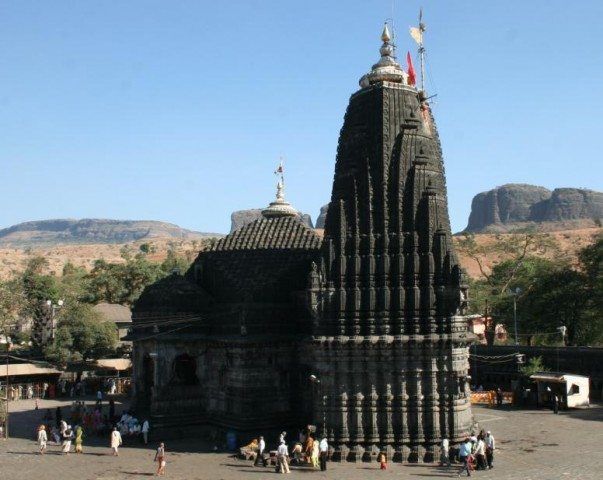
Trimbakeshwar jyotirlinga is one of the most unique jyotirlinga among the twelve Jyotirlingas. This Jyotirlinga is swayambhu and huge. I think after Somnath and Mahabaleshwar the size of trimbakeshwar jyotirlinga is the biggest. This jyotirlinga does not have pindi in the middle but it has a hole in the middle and inside the hole, there are three pindies of Brahma, Vishnu and Mahesh symbolically. And on the Pindi of Lord Shiva, Varuna Devta continuously does abhishekh by pouring water. Nobody knows from where the water comes and does abhishekh on Lord Shiva’s pindi , but it does. One of the miracles. But to see that abhishekh one has to enter the garbagriha of Trimbakeshwar Temple . But darshan is allowed from a distance of 5 meters.
Trimbakeshwar Abhishekh and Women not allowed in the garbagriha
One is not allowed to touch Trimbakeshwar jyotirlinga unless you book a pandit and perform abhisheka. Pandits are moving around the main temple pitching for abhishekh for pilgrims in the queue. If one wants to perform abhishekh of Trimbakeshwar he has to wear a new dhoti and then enter the garbagriha and do abhishekh. So even if you want to touch the jyotirlinga you have to shell out money for abhishekh and new dhoti. That is the rule here in Trimbak.
The worst part according to me is, women are not allowed to enter the garbagriha whatever may be the case. I don’t understand this. I have been to Trimbak more than 5 times and in between I asked a local pandit why are women not allowed inside the garbagriha . I want to perform abhishekh with my wife. They gave reply that in Trimbakeshwar linga Lord Brahma is present so where there is Lord Brahma , women cannot contact. I don’t agree with this and  I don’t know in which Shastra it is written that women are not allowed inside Grabagriha. If any learned person can explain please let me know. This ritual of women not allowed in Garbagriha is in most of the temples in Trimbak and many more specially in Maharashtra. I have seen many husbands going there inside the garbagriha to perform abhishekh of the linga without their wives leaving them unhappy.
A local Pandit in Building Temple in Mumbai says that a married man should always perform pooja with his wife to get the ultimate fruits of it.
The same thing was happening in Kolhapur Mahalaxmi Temple from 2000 years as tradition. But in April 2011, a group of 40 female activists along with Neeta Kelkar the state president of BJP entered garbagriha and performed abhishekh of Goddess Ambabai breaking the 2000 year old tradition. From then women are allowed in the Temple.
 So why don’t women power does the same thing and activity here in Trimbakeshwar ???
Jyotirlinga Darshan
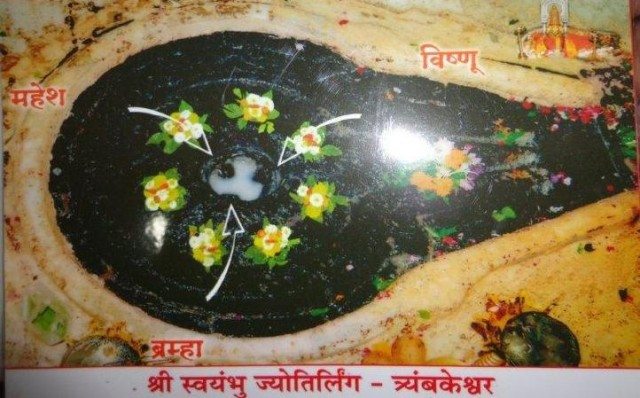
Trimbakeshwar Jyotirlinga
Anyway after around one hour in he queue we managed to have darshan of great Trimbak Jyotirlinga. The jyotirlinga is little bit down below around three feet in the garbagriha . One has to go down through steps from the door and reach there if he is to touch the linga. But in Trimbakeshwar Jyotirlinga only a male person who performs abhishekh along with pandits are allowed to touch the linga hence you have viewed this linga from the entrance of the garbagriha itself.I will tell one thing for sure when one has the darshan of this great linga for just a few seconds, he/she feels great power and sense of bliss and blessings from the Lord. Then after the darshan, one can have peaceful reflective darshan of the Lord in the mirror attached by sitting in the middle of the dome inside the temple.
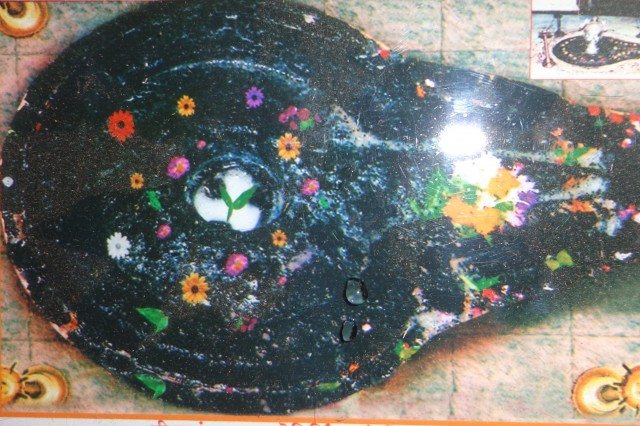
Trimbakeshwar Jyotirlinga
The next place which I am going to show is magical Kushavarta pond
 Kushavarta Kunda a miracle
Kushavarta is a water Kunda in Trimbakeshwar region from where river Godavari takes course. This pond was created by Pandavas.The water of Gautami Godavari Ganga comes from Brahmagiri mountain and gets stored here and from here the river goes towards the main Trimbakeshwar Temple. The mircale here is nobody knows from where the water arrives here in the pond . This pond is always full with the Godavari water , never dries up and nobody knows from where the water leaves the pond and forms the river.
It is said that bathing here removes all sins. During the kumbha mela in Trimbakeshwar the holy men and Naga Sadhus from Himalayas take dip inside this holy pond after gods on the most auspicious time of the mela. The people who performed Narayan Nagbali and Shradh for ancestors are also bathed in this pond.

Trimbakeshwar :- Kushavarta Pond
Around Kushavarta
The whole pond is surrounded by lot of shivalingas, idols of different gods in different forms.The whole boundary of this pond is surrounded by temples made by black stones.
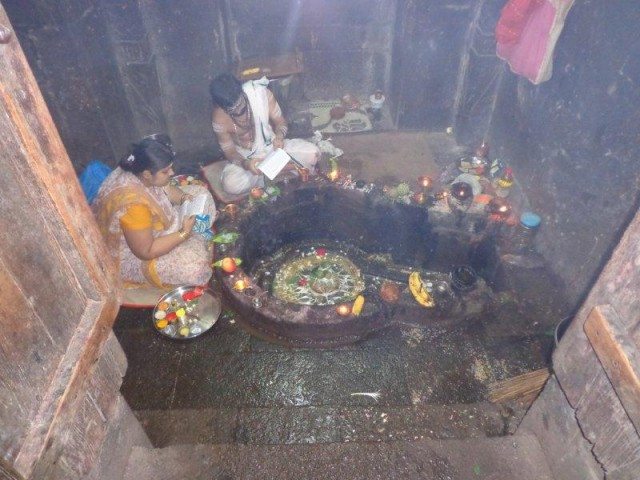
A Lord Shiva Temple near Kushavarta
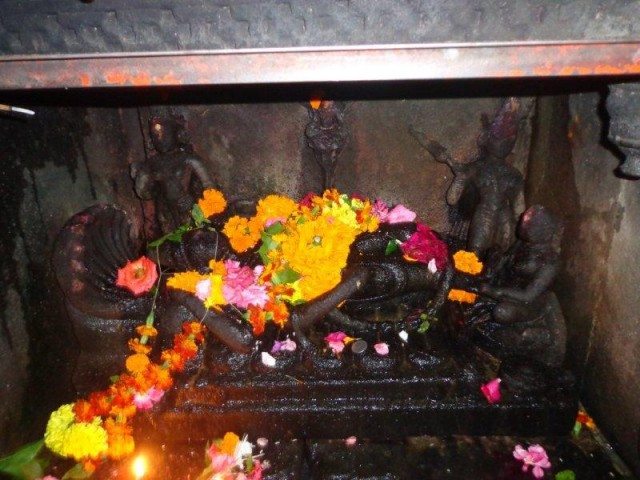

An idol of Lord Vishnu and Laxmi Mata
Although there are many more places in Trimbakeshwar to visit . But I will conclude the post with Saint Nivruttinath Temple .
 Short legend on Saint Nivruttinatth and Samadhi  Temple
Long ago in the eleventh century the Brahmins in Maharashtra became greedy and started to loot people saying unless they pay them they will not disclose the secret knowledge of Bhagvad Gita. At that time Bhagvad gita was wriiten in Sanskrit and only Brahmins had knowledge of Sanskrit language and hence they use to threaten normal people that they will not be able to get Moksha unless they get knowledge of Bhagwad gita which was in  Sankrit language .
Hence in order to establish Dharma Trinity took the form  of four saints brothers and sisters named Saint Nivruttinath ( Lord Shiva), Saint Gyaneshwar (Lord Vishnu), Saint Sopandeo and Saint Muktabai  (Shakti). Saint Nivruutinath avatar of Lord Shiva got Knowledge of salvation from Guru Gorakhnath cave shown in the previous post. And then he shared that knowledge with his younger brother Saint Gyaneshwar after becoming his Guru. He instructed him to translate Bhagwad Gita into local Marathi language so that all people can benefited from the knowledge of God and path of salvation. Saint Gyaneshwar translated Bhagwad Gita into local Marathi language and then this work was called Gyaneshwari which was available to all people then.
Saint Nivruttinath after performing duties in his avatar time took Samadhi in this holy place called Trimbakeshwar. A temple is built on this place above his Samadhi.

Shani-Shingnapur

Apparently, the iron slab and no door situation have a connection. Shani Shingnapur, a village inhabited by population of 5000 odd people, is blessed by the iron-stone slab to protect the place from all the dangers. The iron stone slab is the manifestation of Lord Shani, the lord ruling Saturn. Any person who tries to steal in the village will be cursed with Saade-Saati, an inauspicious period of seven years. If someone tries to put doors on their home, bad things are bound to happen to the people of house. Even the banks do not have any doors here. Unbelievable, isn’t it? But the place does exist.
The legend somehow goes like this.
About 300 years ago, an iron and stone slab washed up in the nearby river during the flood. When the cattle herders poked it with a stick, the slab began oozing blood. In the vision of a villager that night came Lord Shani who revealed that the slab was his manifestation. He told him to put no doors on their houses anymore as he would protect the villagers from any ill-will or danger.
Shani-Shingnapur-925615528s
Ever since then, the custom has followed and the significance of the place has increased with time. The 5-foot iron slab stands erect in the open. There is no roof above the idol because mighty Lord Shani is so powerful that he cannot be contained in a shelter. There is a lamp beside the idol that burns 24/7 and a tree whose branches do not grow over the idol.
What is also unique about the temple is that women are not allowed to worship the idol, a custom that has been followed ever since the slab was erected. Men are supposed to take bath before they enter the temple premises.
Encounter with god here will make you feel safe and feared at the same time, a belief in Lord Shani that is so strong and also uncanny. Shani Shingnapur is a place where houses have no doors, there are trees but no shadow, there are gods but no temples, there is fear but no enemies.
Local Food Tip: After you are done with the prayer and offering, head to the local tea stall for some local staple breakfast vada pav served with hot chili garlic dip. And dhakkan chai, the tea cups that are as small as a bottle cap. You might end up taking enough tea shots to get high on nicotine. Also, enjoy sugarcane juice fresh from the fields and coconut water on your way.

Tuesday, 31 October 2017

Pancha Vayus

The Pancha Vayus

There are five basic manifestations of prana in the body. These pancha vayus – prana vayu, samana vayu, udana vayu, apana vayu, and vyana vayu – direct different aspects of the human mechanism. Through yogic practices like the Shakti Chalana Kriya, you can take charge of the pancha vayus. If you gain mastery over these five vayus, you will be free from most ailments, particularly psychological ones. This is something that the world needs today.
Unless we act now, in the next fifty years, the number of people who are psychologically imbalanced, disturbed, or deranged will increase many times over due to various factors in our lifestyles. We are handling many aspects of our lives in a grossly negligent way, for which we are going to pay the price. If you take charge of your prana, whatever the external situation may be, you will remain psychologically balanced. Right now, a whole lot of people are psychologically imbalanced, though not everyone may have a medical diagnosis.

Prana, Balance, and Health

Suppose your hand does its own thing and pokes you in the eye, scratches you and beats you – that is a sickness. This is what most people’s minds are doing. Every day, the mind pokes them from inside, makes them cry, bawl, or worry – in so many ways, it creates suffering for them. That means it is sick, even if in a socially accepted manner. Every kind of suffering that human beings are going through day in and day out is created in the mind. This sickness has set in, and it will multiply because of the social structures, the technology around us, and various other influences.
One who takes charge of one’s prana can be one hundred percent assured to have unshakable psychological balance. This should also prevent physiological ailments to a large extent, though an element of risk remains due to various reasons, including infections and all kinds of chemicals and poisons that we are exposed to on a daily basis. There is no absolute control over what we take in through the air, water, and food, no matter how careful we are about what we consume. How much impact it has on us depends upon each individual.
Physiological health cannot be guaranteed one hundred percent for external reasons. But psychological wellbeing can be one hundred percent guaranteed if you take charge of your prana. If you are psychologically in an extremely good place, a few physiological issues will not be a problem. Most of the time, minor bodily conditions are less of an issue than the reactions to them that happen in your mind. How the pranas function within you, how they transact with the rest of the universe, how they enter a newborn, and how they leave the dead, all clearly show they have an intelligence of their own.

Shakti Chalana Kriya – Working With Your Prana

It takes a certain level of attention and awareness to know how the five pranas are functioning. The Shakti Chalana Kriya is a fabulous process, but you need to be attentive. It requires you to keep yourself focused for forty to sixty minutes. Most people cannot keep their mind on a full inhalation. Midway, their thoughts wander off, or they lose count or track. It takes months and years of practice to come to a point where you can keep your focus on the breath for the full set of cycles.
That is why Shakti Chalana is always taught in tandem with Shoonya. The Shoonya meditation is to bring yourself to a place where, if you close your eyes, the world is gone in your experience. This is a blessing all of you should earn at some point. Only if you make yourself like this, are you capable of staying focused on something. Forceful concentration is not going to achieve anything.
If you close your eyes, the only things that should exist for you are your breath, your heartbeat, processes in your body, and the workings of your prana. Only what is happening inside is life. What is happening on the outside is just imagery. Even when you look at other people, you are not seeing them out there but the way they are projected on your screen [in your brain].

Staying Focused Is Key

Shoonya and other sadhana are towards that. How far you go is a different question, especially in today’s world. I am not against what is happening today in terms of life around. But unfortunately, to be flaky is fashionable – profound is out. With such an attitude, there is no way you can move your attention to how life works within you. This does not mean that it is not possible for every human being – it is. It all depends on what importance you ascribe to it. If you make it your number one priority, everything within you will organize itself accordingly.
If your priorities are in different directions, you will go all over the place, not getting anywhere in terms of life on a fundamental level. On a social level, you may be getting somewhere. On a physical level, your body is going straight towards the grave – at the most, you can extend the route a little. As far as your mind is concerned, it is going round and round. Only if you focus on the fundamental nature of life will you really get somewhere. The life within you is the only real thing – the rest are just projections. But right now, most of the attention is on projections, not the real thing.
With the Shakti Chalana Kriya, the transformation happens gradually. Taking charge of your prana and its different activities in your system is a fantastic process. The Shakti Chalana Kriya works on that level. If you practice it, you are strengthening the very foundations of your system.

Shambhavi – Beyond Prana

The Shambhavi Mahamudra has the potential to let you touch the dimension that is the basis of all that is. But you cannot actively make it happen. You can only set the ambience. We always refer to Shambhavi as “she.” There has to be devotion for Shambhavi to yield. You can only come in touch with the source of creation – there is nothing for you to do with it. Shambhavi also has an element of pranayam in it, which brings many benefits.
The important thing about the Shambhavi kriya is that it is a tool to touch the source of creation, which is beyond prana. This could happen on the first day, or you could be doing it for six months and nothing happens. But if you keep it up, the day will come when you touch this dimension. If you touch it, suddenly everything is transformed.

Wednesday, 24 February 2016

Brahma and Vishnu worship Lord Shiva

Once, the creator of the universe – Brahma and the protector of the universe – Vishnu started a journey in search of Lord Shiva. They reached the Himalayas after the long travel. They saw an illuminating ShivaLinga there. However, they couldn’t see the edges of it. They decided to find the edges of the ShivaLinga. Vishnu travelled downwards and Brahma upwards. They didn’t reach anywhere despite covering great distances spending many years.
Disappointed, Brahma and Vishnu started to meditate on Lord Shiva. Pleased with the devotion, Lord Shiva appeared before them and asked for their wishes.
Vishnu asked Shiva to give him atleast the chance to wash Shiva’s feet, serving him. Shiva granted his wish. That’s how avatars of Vishnu worship Lord Shiva. Parasuram is one of the greatest devotees of Lord Shiva- He is an avatar of Vishnu.
Meanwhile, Brahma asked if Shiva could be born as a son to him. Shiva was enraged hearing this. Instead of blessing him, Shiva cursed Brahma, “From now on no one would worship you. None of your creation will build temples for you. They’ll never pay homage to you.”
Thus, there are not much temples of Lord Brahma and even no one is named after him.

Wednesday, 11 March 2015

Why Shiva does not worship anybody where as Vishnu worships him in all incarnations?

There is a difference between Bhagwata Purana and Shiva Purana,
A. Bhagwat Puran states that Vishnu is supreme one than Shiva, and From Vishnu, Brahma and By Brahma , Shiva was born but if it so, why Vishnu worship Shiva in all of his incarnations, where as Shiva never worships anybody.
B. Shiva Puran says that Vishnu and Brahma were created from Aadi Anant JyotirStambha of Shiva. When there was a dispute between Brahma and Vishnu about who is the supreme, at that time Shiva appeared as Jyotirstambha and asked both of them to reach start and end of it. Vishnu traveled downwards to reach end and Brahma traveled upwards to reach beginning, but both of them failed and considered there is no end of Shiva and asked Shiva to guide them. In this story Brahma lied that he reached beginning, So Shiva banned his worships in Hinduism, which is true. Brahma's son Daksha Prajapati was against Shiva because of this reason only.
Now, Lord Rama established Shiva Linga when he was marching towards Lanka which is known as Rameshwara Mahadeva means Ishwar(God) of Rama.In Ramayana when Lord Rama wanted to do Prashchatap because he considered killing Ravana as sin of killing a brahmana, he asked Hanumanji to organize to establish a Shiva Linga and asked again Shiva for mercy and to cut his sin. If Lord is himself able to cut sins, Can't he cut his own sins?
In Krishna avatar when Krishna wanted to bring some tree kalpa Vriksha from Indra, he worshiped Shiva for blessings and that is known as "Gopeshwara Mhadeva" in vrindavana means Ishwara (God) of Gopal(Krishna). Also when Krishna wanted to have a son, he asked sages and from their advice he prayed to Lord Shiva to get a son. If Krishna was Vishnu against whose will nothing happens, why he said that "Shive Sarvadhi Sadhike" means nothing happens without Shiva's will, so please bless me with son!! when the Mahabharata was about to be battled he asked Pandavas to have bliss of Shiva first and arranged a Pooja of Shiva Linga...
In Bhahwata Puran also the story is stated about Lakshmidevi's unhappiness with Vishnu because Vishnu told her that in his half area of heart is dedicated to Lord Shiva only. And in the rest of half, all the creatures of world and all deities including her wife Lakshmi lives!!
Parshurama is considered as great devotee of Shiva, Shiva gave him Parshu, for which Parshurama is famous for.
Why Shiva does not worship any body where as Vishnu worships him in all incarnations?
What I think is because Shiva is the only supreme Paramatma as he is unborn(Ajanma), Akarta and Abhokta(Vairagi) as said in Geeta that GOD is Ajanma, Akarta and Abhokta. God is neerakar (Shapeless and formless), Shiva Linga is symbol of Shiva 's such form only.
And also Vishnu always advised other deities(Kartikeya, Indra, Parvati,..) to worship Shiva only if they have mistakenly committed sins.
But now it is curiosity to know about this. Can anybody put light on my doubts?
Vishnu says Shiva is eternal origin(seed) of all things
From The Mahabharata, Anusasana Parva -> Veda Vyasa Mahabharata
The blessed Vishnu said: "I salute Mahadeva. Salutations to Thee. O Thou that art eternal origin of all things. The Rishis say that Thou art the Lord of the Vedas. The righteous say that Thou art Penance, Thou art Sattwa, Thou art Rajas, Thou art Tamas, and Thou art truth.
Vishnu himself said "Shiva is eternal origin of ..." That's why Shiva linga is seed and Whatever we see it is just a tree from that seed.

Story of origin of Godavari river

The story of the Godavari river is told in this excerpt from the Kotirudra Samhita of the Shiva Purana. In this account, the sage Gautama, who is a mind-born son of Brahma, is engaged in Tapasya (deep meditation) on the Brahmagiri mountain when there is a hundred-year drought in the area and thus crops can't grow. So for the welfare of others, he starts engaging in Tapasya to Varuna the ocean god, who appears before him after six months. Varuna denies Gautama's request for rain, because it would go against the wishes of the gods, so Gautama instead asks for "divine everlasting water yielding permanent results." So Varuna tells Gautama to dig a ditch, and then Varuna fills it with divine water and says this:
O great sage, let there be a perennial supply of water in this ditch that has become sacred. This will becomes famous on the earth by your name. Charitable gifts made here, rites performed here, penance pursued here, the sacrifices done here for the gods, and the Shraddha offered here to the manes, everything will be imperishable.
So Gautama and other sages in the area come to the new body of water and start planting crops and the like again. But on one occasion, Gautama sends his shishyas (disciples) to get water, but they're stopped by the wives of the other sages, who want to get water first. The disciples complain to Gautama's wife Ahalya, who goes to the body of water and collects water before everyone else. The other sages are furious at this petty incident, so to get revenge they pray to Ganesha, who appears before them. The sages ask him to force Gautama to leave his hermitage; Ganesha first advises them not to try to harm someone who has only done them good, but they insist.
So Ganesha approaches the sage Gautama, taking the form of a feeble cow, and starts eating Gautama's crops. To shoo the cow away, Gautama throws some blades of grass at it, but as soon as the grass touches the cow he sees it fall dead. Gautama is shocked that he has committed Gohatya (cow-killing), a supreme sin in the Hindu religion, so he takes his wife and leaves the hermitage in order to undertake an arduous course of repentance that involves circumambulating the Brahmagiri mountain, going around confessing his sin to everyone he encounters, and making Lingams to worship Shiva.
enter image description here
Finally Shiva appears before him, and Gautama asks to be made sinless. Shiva laughs and says that Gautama hasn't committed any sins, and that Gautama is such a great sage that even looking at him makes other people sinless. In any case, Gautama asks Shiva for Ganga to be brought there, so that he and others could be purified of their sins. So Shiva gives Gautama "the essence of the earth and heaven" (whatever that means), which was apparently Gautama's inheritance from his father Brahma, and I guess Gautama uses that essence to summon the goddess Ganga. Shiva tells this to Ganga:
O goddess, till the advent of the Kali Yuga, when the son of Vivasvat shall be the twenty-eighth Manu, you shall stay here alone.
I think this is a scrambled translation, by the way; there are only 14 Manus who rule in a given Kalpa, not 28. It probably means "till the advent of the 28th Kali Yuga, when the son of Vivasvat shall be the Manu", because the current Kali Yuga is the 28 Kali Yuga of the Vaivasvata Manvantara. And it probably means the end of the Kali Yuga, not the beginning, because the Godavari river is still here.
In any case, Ganga says that she'll only agree to stay if Shiva also stays there, so Shiva manifests himself as Tryambakeshwara (meaning the three-eyed lord), one of the twelve Jyotirlingas (Lingas that appeared after Shiva manifested as a pillar of light.) Here is a picture of it:
enter image description here
So Ganga agrees to stay there as a new river, initially called the Gautami river but now known as theGodavari river. Gautama and his disciples bathe there to purify themselves of sin. And even the sages who tried to take revenge on Gautama are eager to get rid of the sins. Ganga is initially reluctant to purify these men who had been so cruel to Gautama, but then Gautama convinces her to relent and he digs a ditch for her to emerge from and purify the sages of their sins. That ditch is the famous Kushavartha Thirtha at the Tryambakeshwara temple.
On a side note, like many parts of the Shiva Purana, at least some of this account seems to be a later interpolation, because it apparently references the Pachayata, a group of five gods who are worshipped in the Smartha sect founded by Adi Shankara, so it's an anachronism. Also, the reference to Ganesha may be a later interpolation, because references to Ganesha in the Mahapuranas are few and far between.
You may also be interested to know that this apparently isn't the first universe that had a Godavari river in it; the next chapter of the Kotirudra Samhita of the Shiva Purana gives an account of how a similar story occurred in a previous Kalpa.

Saturday, 14 February 2015

Symbolism of Shiva

In Indian tradition, Shiva Tattva, is often represented in a distinct form of Shankara sitting in meditation holding implements such as Damaru and Trishul. He has a mark of vibhuti on his forehead. He wears a snake around his neck. He has a matted hair with Ganga flowing out from these locks. He has a crescent moon on His head as a ‘decoration’. He rides a Bull called Nandi, his Vahana.

Is this the real form of Shiva or is it a visual representation with each of these aspects of his form having some significance?

Shankara

Shankara etymologically comes from “Sham karothi ithi Shankara”, meaning, “that which does good”.

Thus the form of Shankara brings to bearing that Shiva, the auspicious and with the potential to manifest all goodness, can only be realized through deep meditation, a state when the sound of OM reverberates through our mind, being and senses.

1

Shankara

 Trishul

 The Trishul as the name itself suggests, is a trident, a spear with 3 spikes to it.

2

Trishul

The Trishul of Shiva seems to be conveying the significance of 3 to us.

The 3 Forces of Trinity

At one level, this Trishul denotes the concept of Trinity in the Universe where the Trinity represent the divine forces of the Universe.

What are these three divine forces of the Universe?

In the ancient Indian texts, the Trinity or the divine forces have been expressed as Brahma, Vishnu and Shiva i.e. the creator, preserver and destroyer respectively.

3

Trinity – Brahma, Vishnu and Shiva

The Indian Rishi, seer scientists, have expressed that for the Universe to go through its cycles, this Trinity, these 3 divine forces are an essential requisite and it is essential for these 3 forces of the Trinity to work in tandem.

This concept of Trinity has also been discussed by different civilizations in their own variant forms.

The 3 states of Divinity

At another level, the Trishul or trident of Shiva is perhaps to remind us constantly of the 3 states of Shiva namely

Arupa - Formless,

Rupa-Arupa – Formless Form and

Sarupa – With form.

The 3 states of Man

Trishul also denotes the 3 modes of action in mankind and that which

drives these acts. They are;

1. Kayika, physical actions

2. Vaachika, speech

3. Manasika, to do with the mind

These 3 modes of action do find a equivalence in the 3 states of the

divinity as well, for example

  1. Kayika with Sarupa or manifested form

  2. Vaachika with Rupa-Arupa for the formless form

  3. Manasika with Arupa for the formless

It is pertinent to note here that the ancient Greek divinity of Europe,

Poseidon, also had a trident in his hand.

4

Damaru

 The other prominent implement in Shiva’s hand is the Damaru.

 The Damaru is a rustic, very ancient variety of hand held drum, with a central bead attached to string which swings and beats on both sides of the drum in an alternating manner.

 What is the significance of this Damaru in Shiva’s hand?

                        5                           6

                               Shiva                                                      Damaru                                                                       

Shiva represents the Cosmic being and the Cosmic power that causes the cycles of creation, dissolution and regeneration which happen in regular rhythmic intervals as the acts of Nature.

The implement that best exemplifies the beat of the rhythm is a drum.

The primeval drum is the Damaru.

As Shiva oversees the rhythmic of dissolution and regeneration, the Damaru best exemplifies the implement most needed by Shiva to keep up this rhythm.

The cosmic rhythmic beat is such that, it causes everything in this Universe to merge in unison with this beat and dissolve back into Shiva. This event is therefore called Pralaya. Thus when Shiva beats His Damaru, He causes the Pralaya or natural dissolution of this Universe.

Third Eye-Tryambaka

Tryambaka comes from the roots tri meaning 3 and Ambaka which means eyes.

The name Tryambaka for Shiva thus is said to mean Shiva the 3 eyed.

7

3 eyed Shiva

Modern physiology indicates the presence of a gland called the pineal gland in the brain, behind and between the eyebrows which is considered to be the focal point for concentration. The 3rd eye of Shiva is also but a way to remind us to open our eyes and see, experience Shiva in all the three states, Arupa - the Formless state, Rupa Arupa –  the Formless Form state and Rupa - the Formful state.

The third eye is to realize Shiva in His formless Arupa state which is at once vast, terrific and terrifying.

The Forehead Mark – Vibhuti

Of the 5 primordial elements, the Fire element, Agni, is associated with Shiva. This is exemplified by the story of the Lingodhbhava. Fire acts on anything and everything and reduces it to a state of ash or Bhasma. So Bhasma is a product of Agni or Shiva acting on it. It is considered symbolic of Shiva’s act of destruction for regeneration.

 The word Vibhuti means resplendent or glowing, with extraordinary powers.

 The smearing of the ash or Vibhuti is meant to destroy one’s ego and ignorance and give rise to a new self, glowing with the realization of Shiva.

Moon on head-Chandrasekhara

 The moon weaves a magic in the sky every fortnight.

 Once, the New Moon phase is reached, there is no moon visible from the earth. From there, it grows again and recreates a Full Moon again within the next fortnight as part of a beautiful celestial show of Nature. Shiva as the divinity of regeneration, in His pictorial form, has a very thin crescent moon on His head.

8

Chandrasekhara

This thin crescent symbolically depicts the regenerative aspect in the monthly cycle of the moon from the thin remnants of the previous cycle.

Regeneration is also connected with fertility and what is interesting to note here is that, in humans, the women’s fertility cycle of 28 day period exactly coincides with the 28 day cycle of the moon.

The Chandrasekhara or Somasekhara form of Shiva brings out to us the intrinsic correlation between the phases of the moon, fertility and the humans.

Nandi –The Bull

Shiva’s Vahana, Vehicle is the bull called Nandi. A bull is called Rishabha in local language and it is a Pashu. The loose translation for Pashu is animal. But Pashu is also an encompassing term that includes all living beings or bodily forms.

 Shiva as a principle of the Universe can only be realized through subtler means and not in a physical or gross form. Thus Pashu or bodily forms are a stumbling block in the way towards realizing Shiva.

9

Nandi, Bull

Only when one is willing to go beyond the bodily level of understanding and hones the subtler senses, can one understand and realize Shiva Shankar and peace.

 This Shivaratri, let us imbibe the significance behind Shiva’s visual form as we immerse ourselves in the Shiva Tattva.