After reaching down from Brahmagiri Mountain and Gangadwar in the last post the whole atmosphere in Trimbak became pleasant due to heavy downpour. As there are many destinations in Trimbakeshwar we decided to visit three important destinations among them. All of them are in the circumference of one km.
First of all, I will start with Trimbakeshwar Temple and Jyotirlinga and story behind it.
Legend wise it is the only Jyotirlinga among the twelve jyotirlingas, at the time of its manifestation all the Gods and Goddesses were present including Hindu Trinity of Brahma, Vishnu and Mahesh, Lord Ganesha, Parashakti Mahadevi and Thirty-three crore devtas. Trimbakeshwar is also the place where a drop of nectar fell down during the churning of the ocean , hence a Kumbh Mela is held every twelve years in this place. And hence it is also a place of salvation. It is the only place along with Ujjain where Jyotirlinga and Kumbha Mela both are present. It is only here where Pitrudosha, Karlsarpa dosha are removed by performing poojas like Karlsarpa Shanti Pooja, Narayan Nagbali, and Tripindi Shraddha.
The Legend of Trimbakeshwar Jyotilringa
Long long centuries ago, this place was full of rishis and sadhus who used to meditate here and this land was called one of the tapobhoomi. Gautam Rishi ( one of the Saptarishi ) also stayed here with his Ahilya. Once for 100 years this place was without rain and drought occurred and there was no water. So Gautam Rishi used his tapobal ( power of meditation) and created a small pond full of water for urgent needs.He and his Ahilya wife used to give water to other rishi and their wives only for urgent needs as there was not much water in the pond. Since this was conditional the wives of other rishis became jealous of tapobal of Gautam Rishi and instigated their husbands to do something to get rid of Gautam’s fame and ego. So all the rishis performed Yagna and invoked Lord Ganesha and asked him to become cow and die at Gautam’s hermitage so that he may incur the sin of killing a cow.
Lord Ganesha here warned that this is a misdeed and it will not do any favor. But Rishis were adamant on this one wish. Granting them the wish as a fruit of the Yagna, Lord Ganesha went to Gautam’s hermit in the form of a weak and feeble cow and when Gautam Rishi went to feed that cow she died. Some Rishis saw this and said that a sin of killing a cow occurred to Gautama rishi and his wife Ahilya by this event, and he has to bring Ganga river from heaven to wash his sin by doing penance to Lord Shiva which they felt was impossible for Gautama rishi. Gautama rishi along with wife Ahilya started meditating on Lord Shiva. Many years passed meditating and by his severe penance Lord Shiva became pleased and came along with Brahma, Vishnu, Ganesha, three devis and all the gods at this place to grant him a boon. Gautama asked for River Ganga from Lord Shiva and asked him to stay at this place forever to benefit of mankind. Lord Shiva hits his hair (Jataa) on the Brahmagiri Mountain and from there river Ganga springs up and comes down in name of Gautami or Godavari.
Lord Shiva along with Lord Vishnu and Lord Brahma remained here in the form of Linga . Hence in trimbakeshwar, there is no pindi in the linga , There is yoni and a hole in between. Inside the hole there are three pindies denoting Brahma , Vishnu and Mahesh.This linga is most unique among all the twelve Jyotirlingas of Lord Shiva due to shape and presence of the trinities.
Towards the Jyotirlinga temple
It was already 11.30 PM and there was huge queue . I stood in the queue for about 30 – 45 minutes to have our chance to see the great swayambhu shivalinga of Trimbakeshwar where all the three Trinity are present. While moving on the queue, there are hoardings on the top which tells the story behind this town, its importance, temple construction etc.
Trimbakeshwar Temple
Nandi Bull the vehicle of Lord Shiva has altogether different temple outside the jyotirlinga Temple. Pilgrims first visit Nandi Bull,s temple and then they visit Lord Shiva’s temple. It is mandatory here to visit Nandi first. There is also one kunda near the temple which contains water of Godavari river. This temple has a huge area and is made up of black stones with a lot of small shivalingas in the small temples near the walls. The boundary is also covered with huge fort-like wall to prevent it from Muslim kings. The two kalash of the temples are covered with Gold. This temple was completed in the 16th century and it is said that the cost incurred to built the temple at that time was Rs. 16 lakhs.
Now view the temple pictures
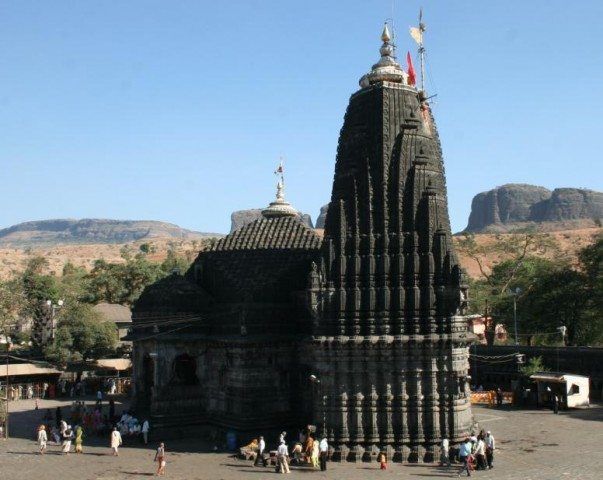
Trimbakeshwar jyotirlinga is one of the most unique jyotirlinga among the twelve Jyotirlingas. This Jyotirlinga is swayambhu and huge. I think after Somnath and Mahabaleshwar the size of trimbakeshwar jyotirlinga is the biggest. This jyotirlinga does not have pindi in the middle but it has a hole in the middle and inside the hole, there are three pindies of Brahma, Vishnu and Mahesh symbolically. And on the Pindi of Lord Shiva, Varuna Devta continuously does abhishekh by pouring water. Nobody knows from where the water comes and does abhishekh on Lord Shiva’s pindi , but it does. One of the miracles. But to see that abhishekh one has to enter the garbagriha of Trimbakeshwar Temple . But darshan is allowed from a distance of 5 meters.
Trimbakeshwar Abhishekh and Women not allowed in the garbagriha
One is not allowed to touch Trimbakeshwar jyotirlinga unless you book a pandit and perform abhisheka. Pandits are moving around the main temple pitching for abhishekh for pilgrims in the queue. If one wants to perform abhishekh of Trimbakeshwar he has to wear a new dhoti and then enter the garbagriha and do abhishekh. So even if you want to touch the jyotirlinga you have to shell out money for abhishekh and new dhoti. That is the rule here in Trimbak.
The worst part according to me is, women are not allowed to enter the garbagriha whatever may be the case. I don’t understand this. I have been to Trimbak more than 5 times and in between I asked a local pandit why are women not allowed inside the garbagriha . I want to perform abhishekh with my wife. They gave reply that in Trimbakeshwar linga Lord Brahma is present so where there is Lord Brahma , women cannot contact. I don’t agree with this and I don’t know in which Shastra it is written that women are not allowed inside Grabagriha. If any learned person can explain please let me know. This ritual of women not allowed in Garbagriha is in most of the temples in Trimbak and many more specially in Maharashtra. I have seen many husbands going there inside the garbagriha to perform abhishekh of the linga without their wives leaving them unhappy.
A local Pandit in Building Temple in Mumbai says that a married man should always perform pooja with his wife to get the ultimate fruits of it.
The same thing was happening in Kolhapur Mahalaxmi Temple from 2000 years as tradition. But in April 2011, a group of 40 female activists along with Neeta Kelkar the state president of BJP entered garbagriha and performed abhishekh of Goddess Ambabai breaking the 2000 year old tradition. From then women are allowed in the Temple.
So why don’t women power does the same thing and activity here in Trimbakeshwar ???
Jyotirlinga Darshan
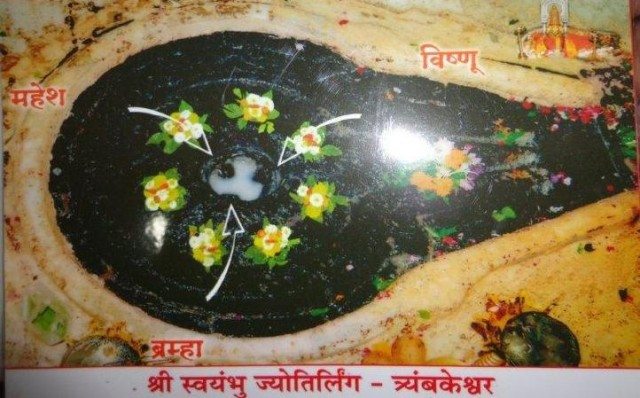
Trimbakeshwar Jyotirlinga
Anyway after around one hour in he queue we managed to have darshan of great Trimbak Jyotirlinga. The jyotirlinga is little bit down below around three feet in the garbagriha . One has to go down through steps from the door and reach there if he is to touch the linga. But in Trimbakeshwar Jyotirlinga only a male person who performs abhishekh along with pandits are allowed to touch the linga hence you have viewed this linga from the entrance of the garbagriha itself.I will tell one thing for sure when one has the darshan of this great linga for just a few seconds, he/she feels great power and sense of bliss and blessings from the Lord. Then after the darshan, one can have peaceful reflective darshan of the Lord in the mirror attached by sitting in the middle of the dome inside the temple.
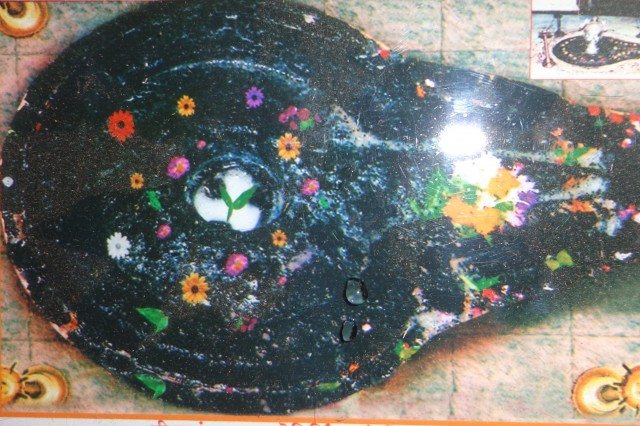
Trimbakeshwar Jyotirlinga
The next place which I am going to show is magical Kushavarta pond
Kushavarta Kunda a miracle
Kushavarta is a water Kunda in Trimbakeshwar region from where river Godavari takes course. This pond was created by Pandavas.The water of Gautami Godavari Ganga comes from Brahmagiri mountain and gets stored here and from here the river goes towards the main Trimbakeshwar Temple. The mircale here is nobody knows from where the water arrives here in the pond . This pond is always full with the Godavari water , never dries up and nobody knows from where the water leaves the pond and forms the river.
It is said that bathing here removes all sins. During the kumbha mela in Trimbakeshwar the holy men and Naga Sadhus from Himalayas take dip inside this holy pond after gods on the most auspicious time of the mela. The people who performed Narayan Nagbali and Shradh for ancestors are also bathed in this pond.

Trimbakeshwar :- Kushavarta Pond
Around Kushavarta
The whole pond is surrounded by lot of shivalingas, idols of different gods in different forms.The whole boundary of this pond is surrounded by temples made by black stones.
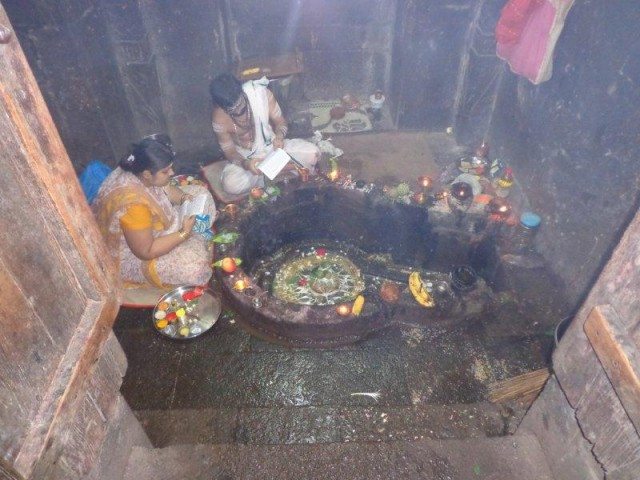
A Lord Shiva Temple near Kushavarta
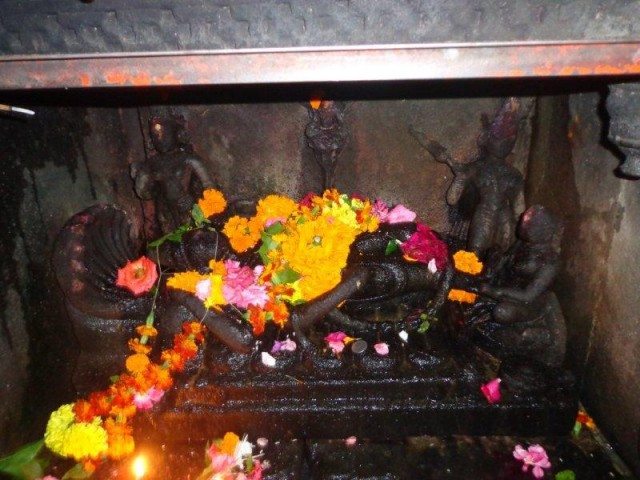
An idol of Lord Vishnu and Laxmi Mata
Although there are many more places in Trimbakeshwar to visit . But I will conclude the post with Saint Nivruttinath Temple .
Short legend on Saint Nivruttinatth and Samadhi Temple
Long ago in the eleventh century the Brahmins in Maharashtra became greedy and started to loot people saying unless they pay them they will not disclose the secret knowledge of Bhagvad Gita. At that time Bhagvad gita was wriiten in Sanskrit and only Brahmins had knowledge of Sanskrit language and hence they use to threaten normal people that they will not be able to get Moksha unless they get knowledge of Bhagwad gita which was in Sankrit language .
Hence in order to establish Dharma Trinity took the form of four saints brothers and sisters named Saint Nivruttinath ( Lord Shiva), Saint Gyaneshwar (Lord Vishnu), Saint Sopandeo and Saint Muktabai (Shakti). Saint Nivruutinath avatar of Lord Shiva got Knowledge of salvation from Guru Gorakhnath cave shown in the previous post. And then he shared that knowledge with his younger brother Saint Gyaneshwar after becoming his Guru. He instructed him to translate Bhagwad Gita into local Marathi language so that all people can benefited from the knowledge of God and path of salvation. Saint Gyaneshwar translated Bhagwad Gita into local Marathi language and then this work was called Gyaneshwari which was available to all people then.
Saint Nivruttinath after performing duties in his avatar time took Samadhi in this holy place called Trimbakeshwar. A temple is built on this place above his Samadhi.

